
The 2026 AI Operations Report, produced with Oxford Economics, surveyed 800 U.S. business and technology leaders, including 125 consumer and business services (CBS) organizations. The findings point to a problem these firms know well: AI might be running, but measuring its ROI is another matter.
The raw material for measuring AI’s performance is already there. Utilization, fill rates, first-time fix rates, and invoicing cycles have lived on your dashboards for years, complete with built-in baselines.
What’s missing is a clear line connecting those existing numbers to what your AI is actually doing.
When AI works in a service business, it gives your team time back. It helps estimators price more jobs, recruiters screen deeper talent pools, dispatchers catch routing errors before a truck rolls, and consultants reach conclusions faster. None of that gets recorded unless you decide — before the pilot — which existing metric the AI is supposed to move. If you aren’t tracking that connection, you can’t prove the ROI.
Measuring AI ROI Ranks Near the Top as a Problem and Last as a Priority
When asked what holds back their AI pilots, 49% of CBS firms pointed to the difficulty of measuring success — near the top of their list.
Yet, when asked about their future focus, better measuring and demonstrating the ROI of existing investments came dead last, at 11%.
As a result, companies keep investing in building new tools while spending almost nothing to see what actually worked. That is a reasonable instinct early on, when you’re still experimenting. It becomes expensive at the budget review, when finance asks what the last two cycles bought, and there’s no data to show for it. The disconnect shows in the results: only 23% of CBS organizations strongly agree that their AI is delivering measurable business value.
You Can’t Measure AI ROI on a Process Nobody Has Defined
The measurement problem starts further upstream, with undefined processes.
Data access, quality, and preparation are the most common reasons CBS initiatives stall at setup, cited by 72% of firms. The report traces this back to deeply siloed systems — often the legacy of years of acquisitions — that keep information from moving cleanly across the business.
This fragmentation is more than just a data issue; it also makes the underlying business processes difficult to standardize. In the survey, 52% of CBS organizations named a lack of understanding of the business process being automated as what’s most commonly missing when AI falls short. Across all 800 organizations, that figure sits at 43%, making it the single most common capability gap in the research.
If your firm grew through acquisitions, you know exactly why this happens. The same job runs four different ways across four legacy systems because nobody has needed to reconcile them. Proposal development at the Denver office looks entirely different from the Colorado Springs office acquired in 2021. Dispatch at the original branch doesn’t match the three branches that came with the last acquisition. Until someone decides what the standard process is, you have nothing stable to measure.
AI Ownership: Somebody’s Job Has to Be the Number
In most CBS organizations, AI has a sponsor rather than an owner. While 57% of firms hand primary AI decisions to IT leaders, just 9% have built a dedicated AI or transformation team (compared to 18% across industries).
These sponsors already have a practice to run, crews to staff, or a P&L to defend. They rarely have the mandate to audit a process, establish a standard version, choose the metric AI should move, and answer for the results if it fails.
Fixing this doesn’t require adding headcount. A single person with protected time and the authority to settle process questions across your business units can do the job. The mandate has to be explicit, and the accountability has to land somewhere specific.
How to Measure AI ROI in a Service Business: Pick the Metric Before the Pilot
Before your next initiative launches, choose your target metric. In a service business, saved time sits close to the money, because an hour returned is an hour you can bill, dispatch, or spend on the next job. But time saved only matters if it turns into something tangible. Usually, it gets captured as a one-time estimate from the team using the tool, then sits forgotten on a slide.
Take it one step further and tie it directly to the numbers your business already runs on: hours billed, utilization, route density, first-time fix rates, time to fill, or proposal win rates. Pick the single metric that governs the process AI touches, and hold the initiative accountable to it.
If AI drafts the first pass of a proposal, the hours it saves your team are the input. What those hours become is the measure: more proposals out the door, and more deals won.
Set that number before the pilot, and own it after. That is what turns your next budget conversation into a review of what worked.
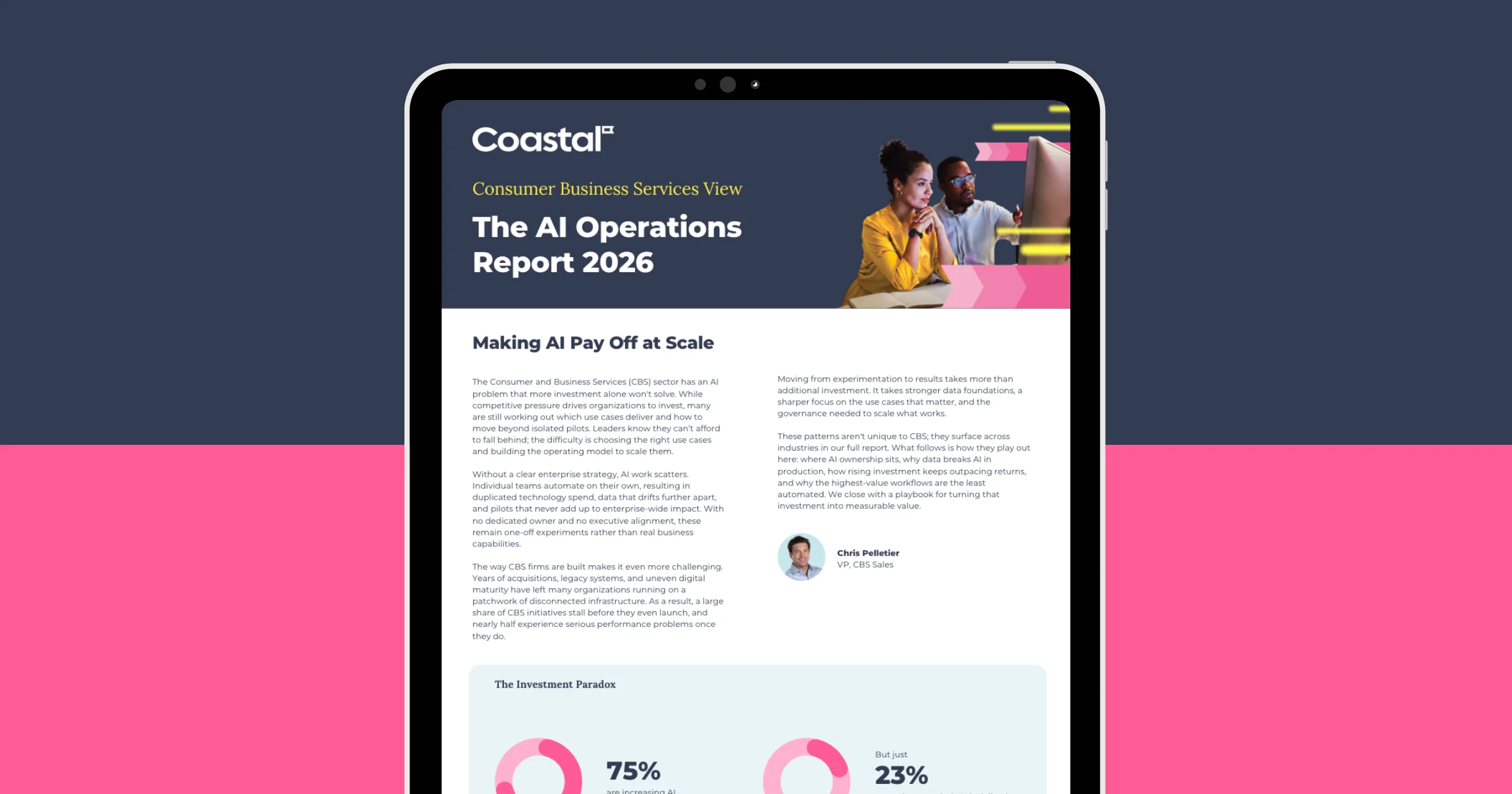
The full Consumer and Business Services AI Operations Report 2026 goes deeper into AI ownership trends, data architecture hurdles, the workflows carrying the most unclaimed value, and a four-part playbook for turning investment into results.
All figures are from Coastal’s 2026 AI Operations Survey, conducted with Oxford Economics among 800 U.S. business and technology leaders, including 125 consumer and business services organizations (professional services, consulting, accounting, waste management, home services, staffing, and construction). All respondents have at least one AI initiative in production today.