Salesforce announced Headless 360 at TDX and reinforced it at Agentforce World Tour NYC. The headlines have framed it as Salesforce going “no browser required.” That’s catchy, but not the most helpful way to communicate what was announced. The more useful read is that Salesforce is acknowledging how AI is changing the way people work, and rebuilding the platform around that reality.
There are three things worth understanding in order to make strategic decisions this quarter. First, what “headless” means in this context and how it introduces flexibility. Second, why Slackbot (not Agentforce) is the product competing with Claude and ChatGPT as your team’s everyday AI assistant. And third, what to do next based on where your organization sits on the agentic AI maturity curve.
If you’re familiar with Salesforce but newer to agentic AI and headless concepts, what follows will help you put the pieces together.
Headless Means More, Not Less
“Headless” in computing generally means without the user interface components that allow a human to use software directly. In this case, Salesforce means you can use its CRM without needing to use its native UI.
Agentic AI (which we’re defining here as AI that can execute tools iteratively to complete tasks) has changed how many people interact with data. We’ve already seen this in the shift in traditional search engine traffic from user-driven to AI-driven queries. Similarly, many organizations have started to experiment with agentic experiences that access systems on behalf of their users. We call this an agentic user interface.
Instead of having to keep 15 tabs open and “swivel-chairing” between them, users can now ask their AI assistant (Claude, Gemini, ChatGPT, etc.) to collect and analyze data from different sources. This has bred a lot of debate within traditional SaaS providers. Some have decided to block, or at least charge additionally, for AI accessing their applications versus humans. With Headless 360, Salesforce is stating they’re not going to go that route.
Want to use Slackbot? Salesforce will support it. Your organization uses Claude or ChatGPT Enterprise? They can use Salesforce, too. Want to build your own UI from scratch using React.js? That’s now supported on platform. Want to use the Salesforce Lightning UI? You still can, and many people will.
Here, headless doesn’t mean that Salesforce is “losing its head”, but rather, Salesforce is allowing you to bring your own user experience and supporting all experiences on top of the platform equally, not just its Lightning UI.
From the User Interface to the Agentic User Interface
But hasn’t Salesforce always supported externally accessible APIs? What’s actually new news here?
Well, yes. Viewed through that lens, this isn’t new at all. But the conversation changes when we start bringing agentic AI into the picture.
First, let’s think about how we design Salesforce processes for human users. We build page layouts and user experiences that guide the user on what to do and when. We place buttons, define screen flows, code Lightning Web Components, and define validation rules to limit what the user can do and steer them down their recommended next steps in a business process.
To bring AI into these processes, you can expose general platform APIs to an agent, but that isn’t a strong guarantee of success. Every Salesforce org is built differently, so knowing how to call those APIs and what to ask for requires a lot of context-relevant instructions. We can’t expect our users to prompt their AI every time: “Go to this object, search for this value across these field names, then search for child records, and then…”
So if agents don’t work in a traditional UI and it’s inefficient for users to direct them with detailed prompts every time, how can we provide them with a similar level of guidance and structure?
This is where Model Context Protocol (MCP) servers come in. MCPs allow us to define specific tools for the AI to execute, along with natural language instructions on how and when to use these tools. If we expose the right tools to the agent, then it’ll more likely choose to do the right thing at the right time.
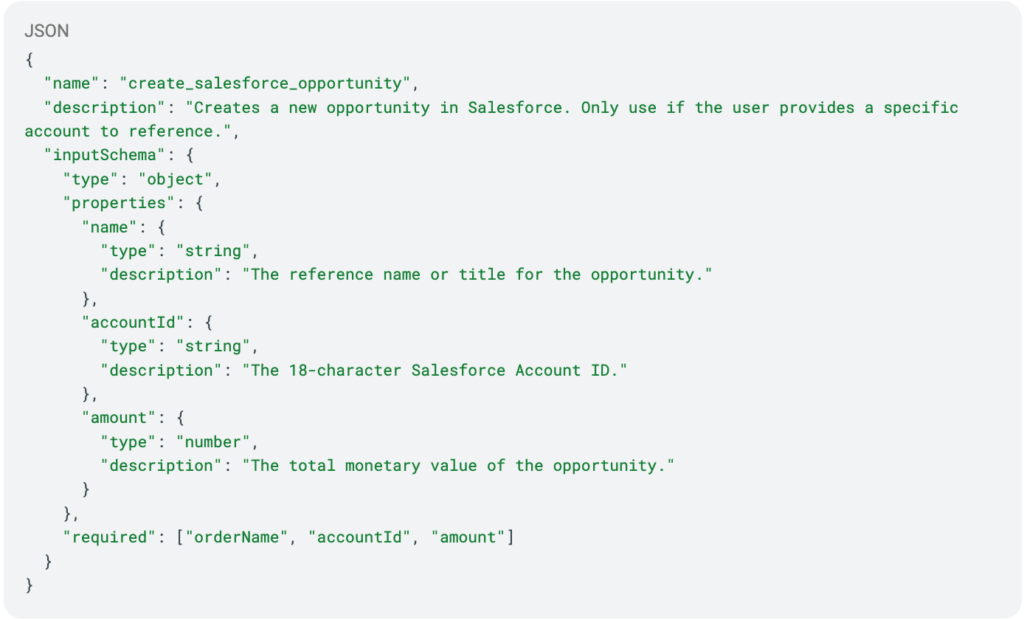
What Salesforce has decided to do is support the building of MCP servers in Salesforce, so you can publish custom, use-case-specific tools to your AI. And if you architect them correctly, you can even reuse the same automations that you surface to your human users.
This means if you’re working in the Lightning UI, or you have Claude connect to the Salesforce org to take actions on your behalf, you’re both following the same processes.
That’s the connection that Salesforce has been missing, and the key part of what they’re communicating to us that they’re going to support. But just because they’re supporting these new Agentic User Interfaces doesn’t mean they aren’t bringing their own.
Slackbot, Not Agentforce, is the Feature Competitor to ChatGPT and Claude
Make no bones about it—Slackbot just works. Salesforce built it on its own internal Slack implementation and has been investing heavily in it, learning from the broader industry’s successes (and failures) with agentic AI assistants. But why does it work so well?
Partially, they’re building on Anthropic’s family of models. Those models are efficient, performant, and definitely frontier-level.
But mainly, it’s because Slackbot is an agentic user interface that’s as close to your data as possible.
Because this interface lives in Slack, they’re able to build on top of a world-class conversational user experience. And because your internal and even external communications live there, it already has a wealth of contextual knowledge that Salesforce can natively build around.
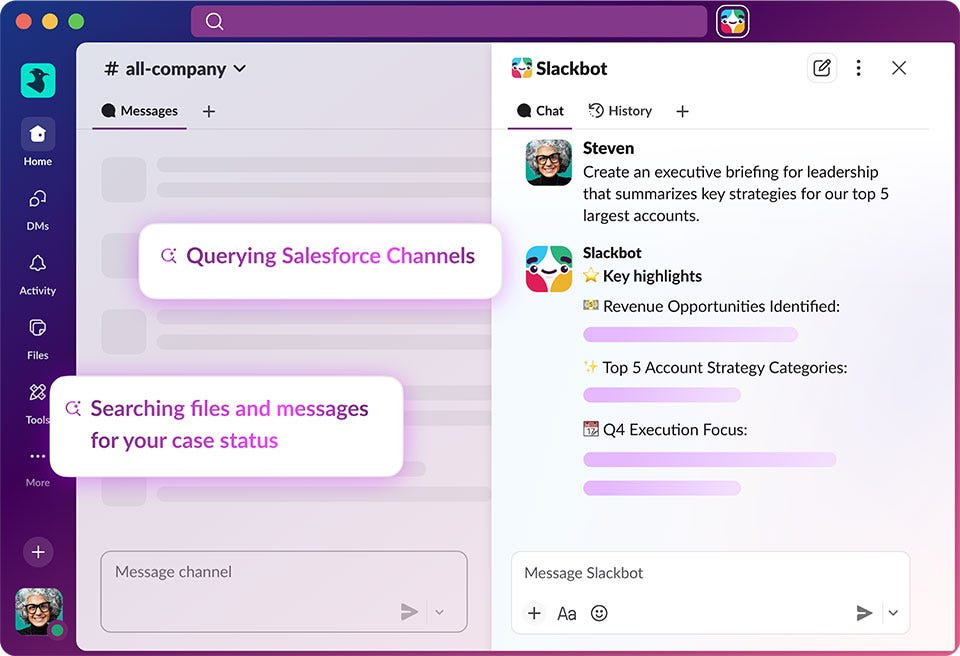
Rather than needing to integrate with an external system and define MCPs for Slack, Salesforce can define its behavior around all the massive data you have in Slack, complete with timeliness and context. This automatically gives it a leg up on external, third-party agentic user interfaces, which require additional integration and prompting to understand how your organization works and uses each tool.
Salesforce has committed to supporting external MCPs for Slack, and they’ve been pushing some really incredible updates lately. It’s likely it will be able to take the place of “traditional” agentic user interfaces like ChatGPT and Claude for Salesforce/Slack-centric organizations.
Frankly, this is an experience that many hoped Agentforce would provide, but that’s now shifting. At Coastal, we see Agentforce as the extension of the core platform that allows organizations to build complex processes leveraging AI, whereas Slackbot is the natural AI assistant for employees.
What You Can Do Today
What we’re seeing is a new modularization of Salesforce, where we can think separately about our enterprise data (Data 360), our deterministic processes (Customer 360, or the “CRM” for the rest of us), and our agentic user experience (Slackbot). You don’t have to buy into all of these to succeed with Salesforce, but they’re meant to work tightly together and reduce the technical and interoperability lift of bringing in third-party solutions.
If you’re still early in your agentic AI maturity, this means you have options. You should definitely consider Slackbot as a starting point, especially if your organization already uses Slack, because it takes so much of the configuration admin out of the equation and gives your users an out-of-the-box experience with real value.
If you’re piloting or in production today on Claude, Gemini, or ChatGPT, this opens much more robust doors to integrating those agentic user experiences with Salesforce. You should consider the specific use cases that your users want to integrate with Salesforce to achieve. Then start defining the deterministic tools within Salesforce that need to be built for AI to leverage, just the same as you do for your human users.
Of course, if your organization is already using autonomous agents, you can use these MCP servers to support that functionality as well, but you need to take strong care around monitoring, permissions, and controls to ensure your autonomous agents don’t go off the rails.
And there are some non-AI benefits, particularly around the new React support that’s also part of Headless 360. This is going to open the door for more nuanced, customized user experiences—especially for external users like customers and partners—beyond the declarative UX that Experience Cloud builder gives us today.
Looking Ahead
Headless 360 provides an accessible view into the future of Salesforce as part of an organization’s operating platform. Salesforce is acknowledging the current, real-world impact of AI today: it’s providing efficiencies to nearly every knowledge worker, but there are definite preferences as to where employees like to work with AI.
Salesforce is embracing this reality, creating a more composable operating platform instead of building up walls. The value of Salesforce’s core Customer 360 is what it’s always been—a deterministic, 100% predictable and reliable platform on which you can define your must-always-be-followed business logic and structured view into your customers. It’s a critical requirement in an age where probabilistic, “it’s usually right” AI agents are now being relied upon to augment business functions.
The next challenge is figuring out which of these new options fit your organization, in what sequence, and at what cost. Headless 360 expands what’s possible, but it can’t decide what’s right for you—that strategy is still yours to figure out.
That strategic decision-making is the work we do at Coastal. We help organizations evaluate Headless 360 in the context of their own architecture; sequence Slackbot, Agentforce, and external AI adoption in a way that fits their maturity; and design the MCP layer that makes any of this work in production.
If you’re thinking through these decisions, let’s talk.