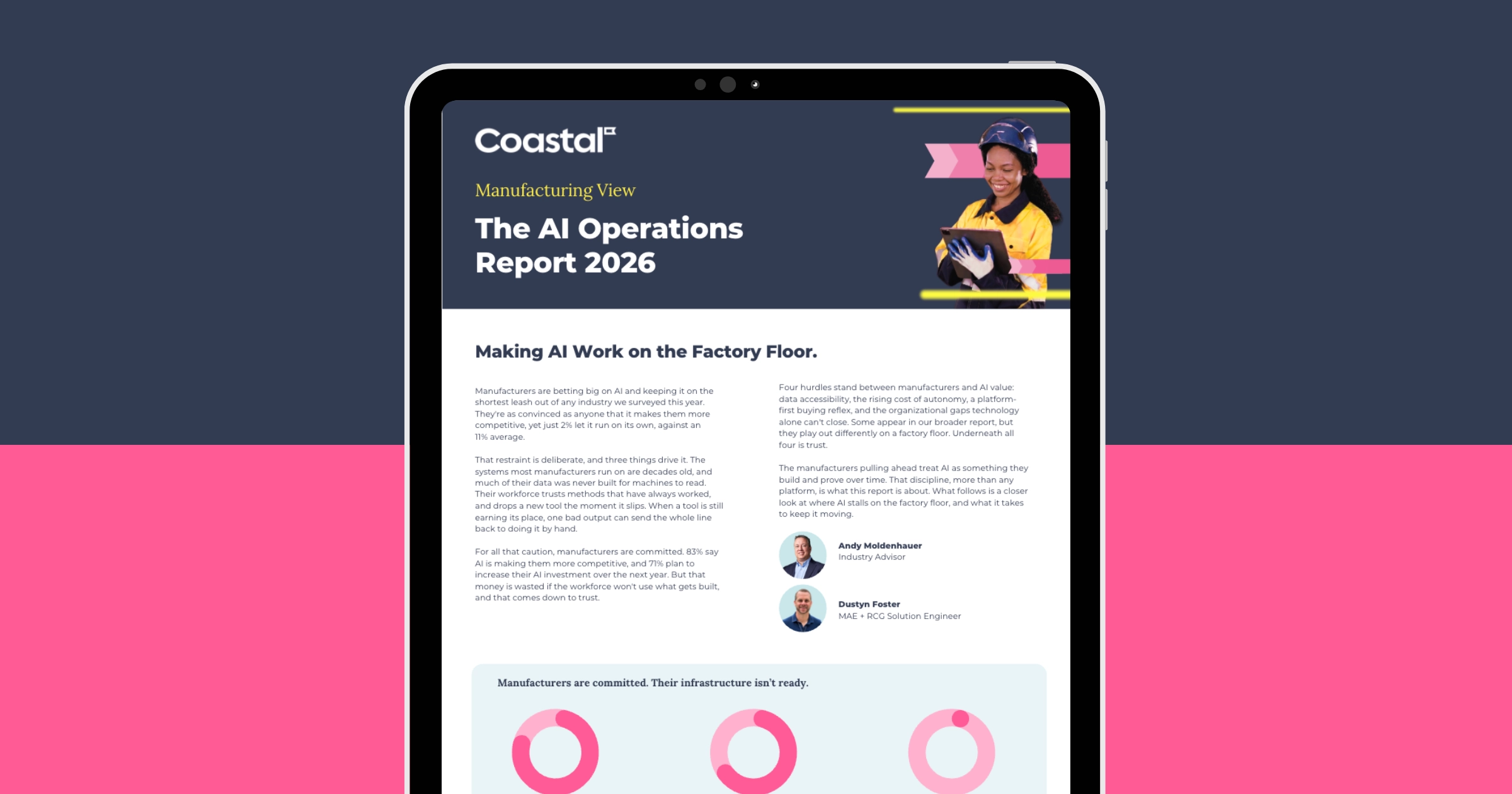

Among 100 manufacturers in this year’s AI Operations Survey, Coastal’s research with Oxford Economics found that 83% say AI makes them more competitive. Only 15% strongly agree it’s delivered measurable business value. Belief runs ahead of proof.
Those same manufacturers give AI little room to act alone. Just 2% run it autonomously in the background, less than a fifth of the cross-industry rate. The close supervision and the missing proof are connected, and both start with the conditions on the factory floor. Here’s what the survey shows, and what our manufacturing team sees behind the numbers.
Why Manufacturers Limit Autonomous AI
Almost no manufacturer lets AI act on its own, and on a factory floor, the reasons are practical. An error on a line doesn’t stay put: a wrong part number or a misread order travels into every step downstream, so someone has to catch it before it multiplies.
Cost pushes the same way. Vendors keep adjusting how they charge for tokens, and our teams hear the same reaction from manufacturers who let an agent run unattended: the bill arrives higher than anyone forecast, and a person starts to look cheaper and easier to predict.
There’s a subtler reason to keep a person in the loop, and it’s about trust.
Think about the Domino’s pizza tracker. Domino’s dropped its thirty-minute delivery guarantee in the U.S. decades ago and never brought it back. What it offers now is a tracker that shows where your order is, and customers accept that trade. Visibility does the work that a promise used to do.
A factory floor requires that same visibility to manage operational risk. Where the instinct is to trust the way things have always been done, you cannot rely on a promise that the AI will get it right — not when an unverified error can travel downstream before anyone catches it. Operators need to see the work and check the output before taking action. This oversight provides the control necessary to use the tool safely, which is why AI in manufacturing tends to sit where the output is concrete and a person can verify it.
Data Challenges in Manufacturing AI
Placing AI where a person can check it addresses the risk. It doesn’t touch the deeper constraint, the data underneath, and that’s the one manufacturers can change.
In the survey, data is the most common place AI stalls: 73% name it, ahead of any other stage. The main character in an AI project is always the data. An agent can only act on what it can read, and much of what a factory runs on was never written for a machine to read: a scanned work order, a spec buried in a PDF, a field that was always filled in by hand.
That gap doesn’t close at launch, and it’s the same one sitting under the thin proof from the opening. An agent working from data it can’t fully use produces results no one can fully stand behind. The work to fix it is a cost most manufacturers don’t budget for.
What’s changed is the tooling: the same AI that stalls on messy data can now do much of the cleanup itself, so the data project moves faster than old spreadsheet-and-legal-pad methods, even if it doesn’t cost less. That work improves two things: the agent gets more dependable, and so does the case for what it delivered.
The Tech-First Trap in Manufacturing AI
The purchase of AI usually outpaces the deliberate process of running it.
In the survey, 41% of manufacturers began with a platform or technology and then looked for use cases to fit it. The pull comes from two directions:
- Embedded Software: AI already ships inside the software teams use every day, arriving with a platform update rather than a purchase decision. If it works that smoothly there, the assumption is it should work here.
- Competitor Moves: When a competitor adopts AI, the cost of waiting looks higher than the cost of moving early.
But starting from the platform leaves you with capable technology and no outcome attached to it, which is one more way the proof stays missing.
What Separates Scaling AI From Pilot Purgatory
The manufacturers who get past their first pilot tend to complete a full cycle: build one agent, measure what it did, decide whether it earned its place, then start the next one knowing more than they did before. Programs stuck in pilot purgatory launch, then launch again. The deciding step never happens.
That middle step is where proof comes from, and it’s the one most often skipped. Skip it long enough, and you accumulate agents nobody has evaluated, which is another way of describing belief without proof.
Two things make the cycle possible:
- Start with manual baselines: Look for work a person could already do manually and confirm it, such as inventory scanning or EDI order processing, so there’s a baseline to measure against and someone who can verify the output.
- Keep it small: Ensure the first agent is sized so it can be completed and evaluated quickly. An agent scoped so broadly that no one can say whether it worked is more of a bet than a pilot.
Do that, and the same verification requirement that keeps humans in the loop starts producing the proof that’s been missing.
The full Manufacturing AI Report lays out the operating disciplines behind that cycle: how to treat the AI project as a data project, where to draw the line between augmentation and autonomy, what governance to put behind an agent, and how to define value before launch so it holds up at the budget review.
Findings are drawn from Coastal’s 2026 AI Operations Survey, conducted with Oxford Economics across 800 U.S. business and technology leaders. This report reflects the 100 manufacturing organizations that were part of the larger survey. All respondents had at least one AI initiative in production at the time of the survey.