
Key Findings at a Glance
The Problem Gets Defined After the Platform: 12% began their most recent AI initiative with a clearly defined problem. Three-quarters started with a vendor’s recommendation or a platform instead.
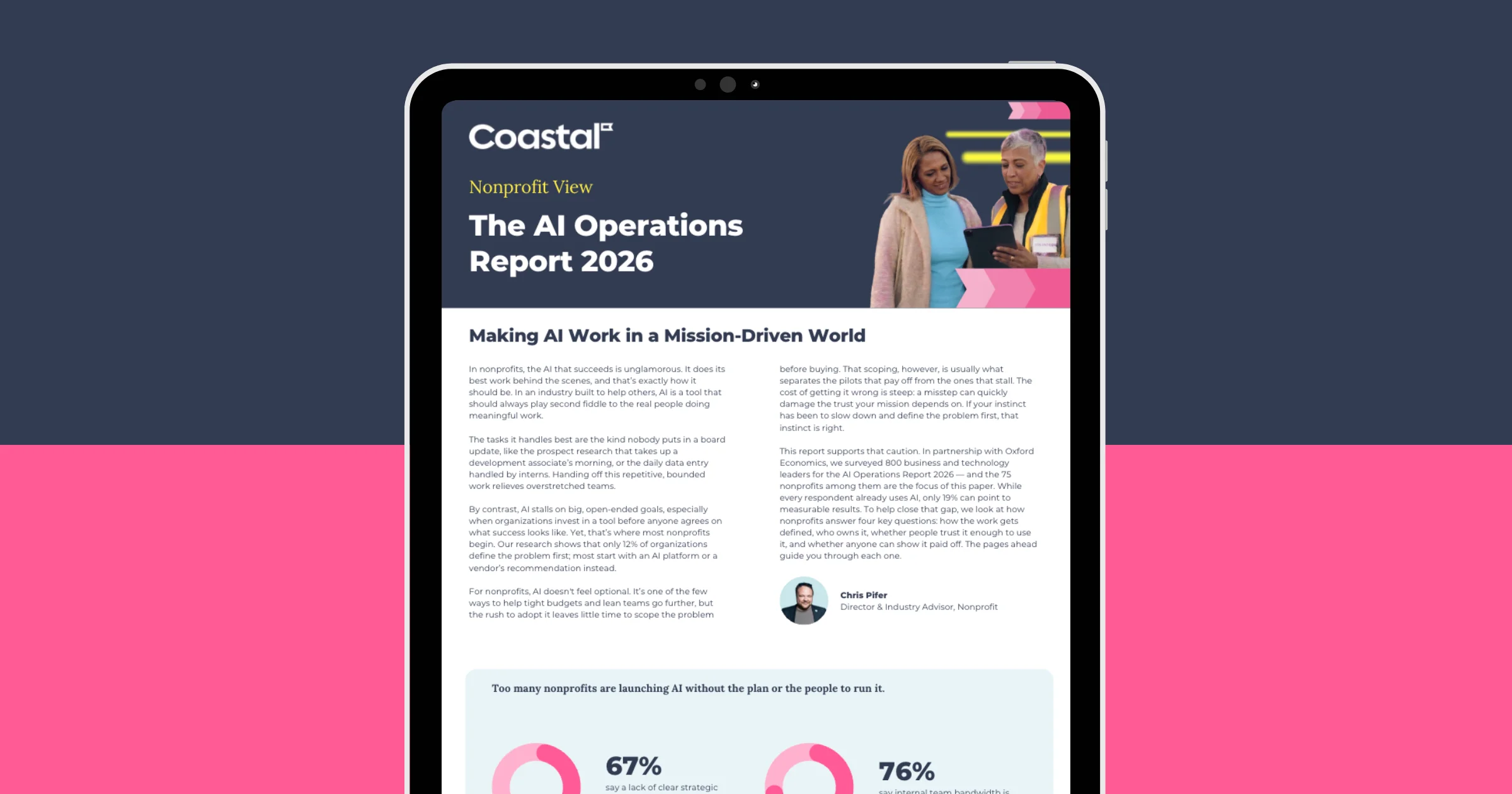
Launching Without the Plan or the People: 67% say a lack of clear strategic direction is limiting their AI pilots. 76% say the same about internal team bandwidth, against 58% across the full survey.
Budget Is Not the Barrier: Only 28% name budget as a constraint, and just 11% have a dedicated AI or transformation team.
Willingness Is High, Trust in the Output Is Not: 79% of leaders say employees are eager to work with AI, yet 53% say staff did not trust the outputs enough to act on them.
Time Savings Get Measured, Impact Rarely Does: 45% measure success mainly by time savings, and only 19% strongly agree AI has delivered measurable value.
Every nonprofit in this survey is already using AI. Only 19% can point to measurable results.
That gap is documented in Coastal’s 2026 AI Operations Report, conducted with Oxford Economics across 800 U.S. business and technology leaders, all at organizations with at least one AI initiative in production. This blog covers the nonprofit report: 75 organizations surveyed on what happens after AI goes live.
Four questions determine what nonprofits get back: how the work is defined, who owns it once it is live, whether employees trust it enough to act on it, and whether anyone can show it has paid off. The survey finds gaps at all four.
Why Nonprofit AI Projects Start With the Platform
Just 12% of surveyed nonprofits began their most recent AI initiative with a clearly defined problem. The rest started elsewhere: 37% adopted a vendor’s recommended use case, another 37% chose a platform first, and 13% never settled on a scope at all. Driven by the pressure to keep up, most reach for a tool before naming what it’s supposed to fix.
67% cite a lack of strategic direction or leadership as a constraint on their AI work, and 60% name problem definition and requirements gathering as points where initiatives stall. Nothing is named more often, and nothing sits earlier.
Who Owns AI in Nonprofit Organizations
Money is a constant concern in this sector, but it’s not the main barrier to AI success. Only 28% cite budget as a top constraint. The real limit is staff time, with 76% pointing to team bandwidth, well above the 58% across the full survey.
That shows up in where ownership sits. 61% place AI under IT leadership, 16% under a program or operations lead, and 11% under a dedicated AI team. For most of these organizations, AI lands on someone whose plate was already full.
The work doesn’t pause for that. 72% struggle with data accuracy or availability once AI is live, and 56% face maintenance demands beyond what they planned. Without a dedicated owner, an agent that worked at launch falls out of step as programs change and staff turns over.
Where Nonprofit Staff Stop Trusting AI Output
79% of nonprofit leaders say their employees are eager to work with AI, but actual buy-in stays tenuous. When these systems fall short, 53% say staff did not trust the outputs enough to act on them.
Much of that skepticism traces back to the initial setup. 60% say the issue their AI addressed turned out to be less valuable than expected, and a tool aimed at the wrong challenge does not earn a team’s confidence.
How Nonprofits Measure AI, and What It Misses
Nonprofits can tell you AI is saving time, but not whether it’s advancing the mission. 45% measure success mainly by time savings, which show up almost anywhere the technology runs. Only 19% strongly agree AI has delivered measurable value.
Time savings is easy to document, but harder to tie to mission impact. Without stronger proof, a pilot rarely gets expanded or ended. It sits there drawing budget and staff hours it never earns back.
What the Nonprofit AI Report Covers
The full nonprofit report works through the four questions in depth:
- How the work gets defined: How to scope a first initiative when the pressure is to buy now, and what that discipline protects.
- Who owns it: What ongoing AI ownership requires at organizations that cannot staff a dedicated team, and where those hours come from.
- Whether people trust it enough to use it: Which use cases build staff credibility, and the sequence to follow before AI reaches a donor or a constituent.
- Whether anyone can show it paid off: How to set a baseline before launch and choose metrics that hold up in a budget review.
It also names the four challenges that arrive after launch, and closes with a five-part playbook covering strategy, data, ownership, adoption, and measurement.
Findings reflect responses from 75 nonprofit organizations in Coastal’s 2026 AI Operations Report, a survey of 800 U.S. business and technology leaders conducted in partnership with Oxford Economics. All respondents have at least one AI initiative in production today. Some figures cited here come from underlying survey data and do not appear in the published industry report.