
Key Findings at a Glance
- High Deployment, Low ROI: 88% say AI has made them more competitive and 61% run 4+ AI initiatives in production (vs. 40% cross-industry), yet only 21% strongly agree it delivers measurable business value.
- Accuracy Without Workflow Fit: 55% report AI outputs that were accurate but failed to fit real-world workflows, against 46% across all industries.
- Data & Adoption Are the Dominant Hurdles: When initiatives stall, leaders most commonly cite data access and preparation (73%) and post-launch user adoption (63%), compared to building or configuring at 37%.
- Technology-First Scoping: Half (50%) started with a platform choice before identifying use cases, while 36% cite a lack of clear use cases as a barrier to running pilots successfully (vs. 27% cross-industry).
- Bandwidth, Not Budget, Is the Constraint: Only 22% cite budget as a barrier. The real limits are technical and infrastructure challenges (58%), internal team bandwidth (56%), and the fact that only 21% have a dedicated AI team post-launch.
Healthcare and life sciences organizations are running more AI initiatives than most other industries. Proof that it’s paying off is harder to find.
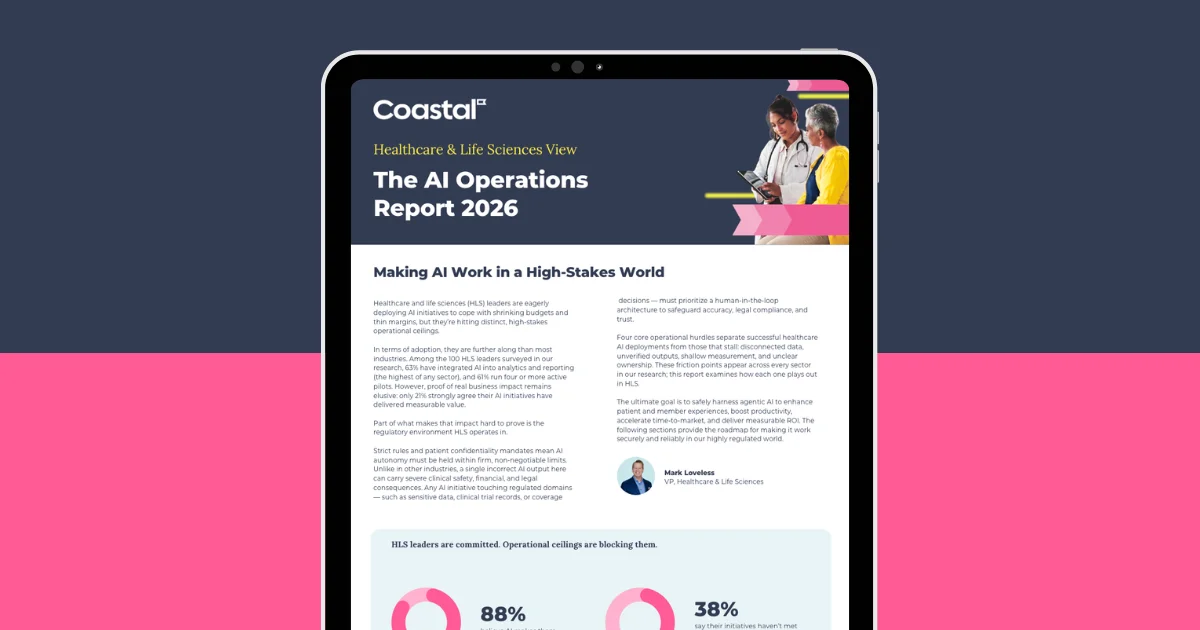
That gap is documented in Coastal’s 2026 AI Operations Report, conducted with Oxford Economics across 800 U.S. business and technology leaders, all from organizations with at least one AI initiative in production. This blog covers the healthcare and life sciences cut: 100 organizations surveyed on what happens after AI goes live.
Among them, 61% are running four or more AI initiatives at once, against 40% across the broader survey. 88% say AI has put them in a better competitive position. Only 21% strongly agree those initiatives have delivered measurable business value.
Why Healthcare & Life Sciences Teams Aren’t Using AI Outputs
Our healthcare advisors describe a sector that moved early and fast. Two years ago, the focus was simply on getting AI in the door. Organizations stood projects up quickly, expecting a fast edge, and in practice, many of those early movers are now the ones reporting the hardest time showing measurable value.
A large part of the reason is that accurate AI still goes unused. 55% of respondents report outputs that were accurate but did not fit the real-world workflows they were built for, against 46% across all industries. The model performs, but the value never arrives.
Healthcare and life sciences deal with workflow fit under a condition most industries don’t: mandatory human review. When AI touches patient records, clinical trial data, or coverage decisions, a human must verify the output before it moves.
When an initiative stalls on workflow fit, we see the breakdown trace back to the type of problem the tool set out to solve:
- When AI targets core clinical or diagnostic synthesis: The reviewer remains legally and ethically liable for the outcome. Because reviewers must inspect raw source data to sign off safely, the AI adds an auditing step to an overstretched team instead of eliminating work.
- When AI targets administrative friction: Administrative use cases, like drafting prior authorizations or capturing ambient clinical notes, succeed because they automate manual prep work rather than forcing humans to audit AI logic.
Accuracy alone isn’t enough. When AI is pointed at high-stakes synthesis without accounting for how humans actually verify decisions, the review step eats the time it was supposed to save.
Where Healthcare & Life Sciences AI Projects Stall: Data First, Adoption Second
When asked where AI initiatives stall, healthcare and life sciences leaders point to two operational bookends: one before the build, and one after.
On the front end, data access, quality, or preparation tops the list at 73%. The core issue is simple: an AI model can only synthesize what it can reach. When patient, clinical, and administrative records sit trapped in disconnected systems, the model operates on partial context, and partial context yields partial results.
On the back end, driving user adoption post-launch is nearly as steep a hurdle at 63%. That comes down to rewiring workflows. When software doesn’t fit cleanly into existing routines, it feels like added effort rather than a shortcut, and staff naturally default to familiar habits.
Healthcare and life sciences organizations face more friction getting data ready and driving adoption than configuring the software (37%). If that matches your own program’s history, the core constraint is likely organizational integration on either side of the build.
Healthcare & Life Sciences AI Implementation Challenges Start Before the Build
Half (50%) of these organizations say their most recent AI initiative began with a platform or technology choice, after which they looked for suitable use cases. Only a quarter started from a clearly defined business problem.
In practice, our team sees a familiar pattern: leadership decides the organization needs an agent, without a clear view of which agent, doing what, for whom. The survey reflects that disconnect: 36% name a lack of clear use cases as a barrier to running pilots successfully, against 27% across industries.
Order of operations matters. Starting with a platform choice puts technology ahead of strategy. Instead of targeting a high-value operational bottleneck, teams end up selecting use cases based on what the tool can do. When a project is scoped around software features rather than a clear business need, it often struggles to deliver a clear return.
AI Ownership and Team Bandwidth in Healthcare & Life Sciences
Budget isn’t what is holding these programs back. Only 22% name budget as a limit on running successful pilots. Instead, two constraints dominate: technical and infrastructure challenges (58%) and internal team bandwidth (56%).
While leaders label this a technical challenge, the issue is often an execution gap: having the skills and data access needed to deploy rapidly evolving software against messy internal systems. The bandwidth limitation is even simpler: nobody has time to manage a new process on top of the one they already run.
Only 21% of these organizations have a dedicated AI or transformation team. Most ask existing staff to maintain models alongside their core responsibilities, and the pattern that follows is consistent. Without people whose actual job is ongoing care and maintenance, initiatives die on the vine. A model that needs continuous tuning cannot be kept current in the margins of someone’s full-time role.
What the Healthcare & Life Sciences AI Report Covers
The full healthcare and life sciences report works through four operational hurdles separating programs that deliver from those that stall:
- Data & HIPAA Constraints: How privacy rules restrict what models can legally access and where outputs can flow.
- Validation Costs: What continuous human verification costs teams already running at full capacity.
- Measurement Realities: What these organizations actually measure, and why those metrics rarely survive a budget review.
- Post-Launch Ownership: Who maintains model accuracy once the build team moves on.
It closes with a four-part playbook covering data architecture, clinical governance, measurement, and ongoing operations.
Findings reflect responses from 100 healthcare and life sciences organizations in Coastal’s 2026 AI Operations Report, a survey of 800 U.S. business and technology leaders conducted in partnership with Oxford Economics. All respondents have at least one AI initiative in production today. Some figures cited here come from underlying survey data and do not appear in the published industry report.