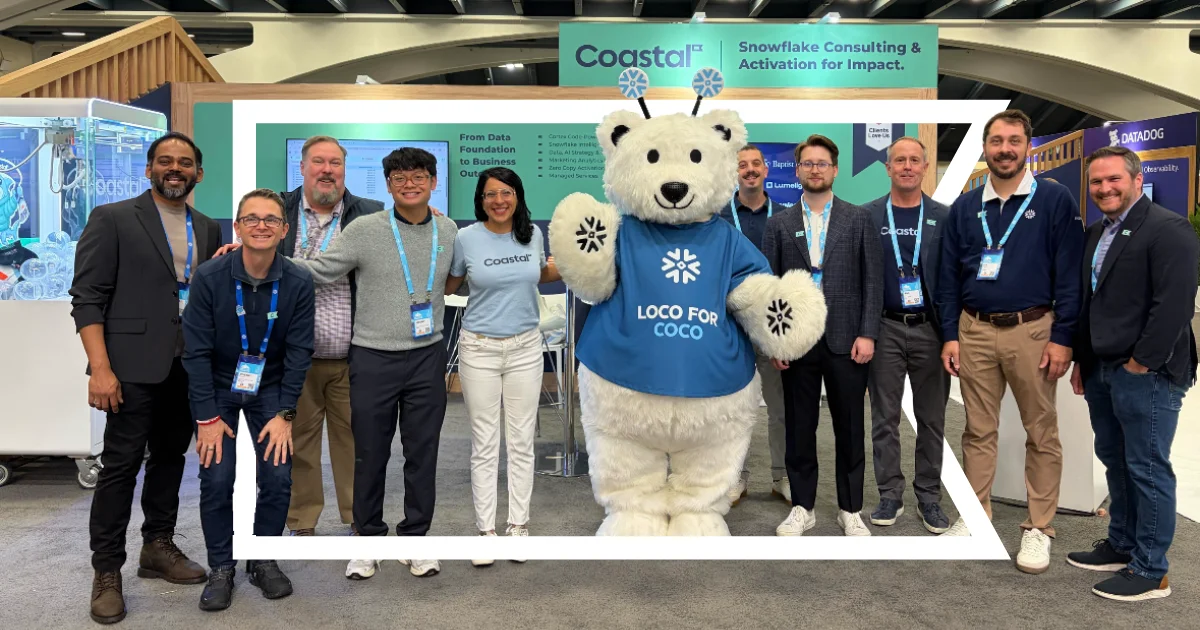
We just got back from Snowflake Summit 2026, and it was big—new product names, live demos, and customer stories everywhere you turned. There were more announcements than anyone could keep up with: Iceberg V3 reaching general availability, Adaptive Compute, Snowflake Datastream, CoCo (formerly Cortex Code), custom model training, and a $6B AWS infrastructure commitment. And just before Summit opened, Snowflake announced they’re acquiring Natoma, an agent governance platform.
Taken together, the announcements describe one shift: AI agents are becoming part of how enterprises operate. Whether your agents will work depends on your data foundation, context, and governance. Here’s what stood out to us, and what it means if you’re leading data, AI, or business strategy right now.
The Agentic Enterprise Is Here
Snowflake is building for a world where AI agents are a core part of how organizations operate. For that to work, AI and data have to live together on the same platform. Otherwise, building agents on top of disconnected systems just recreates the silos everyone has spent years trying to eliminate.
The agent is only as good as what it knows. And what it knows depends entirely on how well your data foundation is built.
Context Is What Most AI Programs Are Missing
One of the more understated announcements at Summit was Horizon Context, which collects signals, metadata, and semantic information and makes it available to AI agents and tools across the platform. Snowflake also gave teams more muscle for building that foundation: CoCo, its AI coding agent, now ships as desktop and mobile apps, so data teams can build and maintain the semantic models agents depend on from anywhere.
The keynote put it plainly: “Intelligence alone is not enough. What you really miss is context.”
This is why so many early AI investments have underdelivered. Organizations deployed capable models on top of data that lacked business definitions, semantic structure and organizational meaning. The output sounded reasonable. It just wasn’t trustworthy or useful enough to act on.
In Coastal’s AI Operations Report, 70% of organizations pointed to data challenges when their AI programs stalled or failed. Agents built on that same data will only scale the problem. Before you build them, define your core business terms—what counts as a customer, an active user, a closed deal—and give every critical dataset a named owner.
Governance Is How You Scale AI
Thomson Reuters made the case on stage: governance has enabled their AI transformation, not complicated it. They’ve built their entire enterprise AI and data platform on Snowflake, a single source of truth spanning more than 37,500 governed tables and 350 data sources. Key workloads supporting CoCounsel and Westlaw are running up to 3.4x faster. More than 1,500 internal users rely on it daily for business-critical decisions.
Snowflake reinforced this with several concrete announcements. Intent-driven governance lets you express what you want protected while AI handles the enforcement. Agent identity tells you when an agent (not a human) is taking action. And multi-party approvals for sensitive operations mean even an admin or an agent can’t make high-stakes changes alone.
Snowflake’s Natoma acquisition takes this a step further: its enterprise MCP governance platform controls how AI agents connect to external systems like CRMs, APIs, and SaaS tools. That’s the layer most organizations haven’t thought through yet, and the deal signals that Snowflake sees agent governance extending well beyond the data platform itself.
For business leaders who’ve watched AI initiatives stall at the security review stage, the lesson is to build governance into the architecture early so it doesn’t become the bottleneck later.
Intelligence Is Moving Into the Places Where Work Already Happens
Snowflake CoWork (formerly Snowflake Intelligence) is evolving into a personalized work engine with user memory, scheduled intelligence, and multi-agent orchestration. The goal is for every person in an organization to have contextual intelligence embedded in how they already work.
Samsung’s team built exactly that: an AI agent on CoWork that reasons over launch performance data across global markets. Questions that used to take hours of routing through analysts now come back in seconds, and more than 1,000 executives, marketers, and sales leaders use it every day. Not one of them is a data scientist. They just get better answers, faster.
That shift from the data team as a bottleneck to every leader as their own analyst is the real payoff. But getting there requires sustained operational commitment. In our AI Operations Report, 48% of organizations said maintenance demands after launch exceeded what they planned for.
Getting agents live is one challenge. Keeping them performing, with the right data, governance, and monitoring, is the longer, harder work. This is what our Waves for Agentic Ops service was built to do.
Zero-copy Is a Bigger Deal Than Most Organizations Realize
Snowflake expanded its zero-copy partnerships at Summit. Salesforce was the most prominent of them, and the same federated, bidirectional access now reaches other platforms like SAP and Workday. Each platform’s data stays in place and is queried live, as if it were native to Snowflake—no ETL and no copies drifting out of sync.
For Salesforce, that means accounts, opportunities, cases, and activity history are available to Snowflake analytics and AI workloads in place, and Snowflake’s models and scores write back the same way. Governance and lineage travel with the data across the boundary, so the access doesn’t create a new policy gap.
In our AI Operations Report, 60% of organizations said integration difficulty is actively limiting their AI’s business impact. Federated zero-copy removes that bottleneck rather than rebuilding pipelines around it.
Most organizations already run these systems and aren’t connecting them this way yet, which makes it one of the rare upgrades that doesn’t require buying anything new.
Coco and CoWork Eliminate the Need for Shadow AI
Snowflake is promoting CoCo and CoWork heavily, and for strategic reasons: it can see that people are already using AI in their company work, and they would rather be the place where that happens securely.
Across every company, employees are pasting customer records, financials, and source code into public AI tools to get work done faster—usually without realizing they’re breaking the data-privacy rules their own company set. Once that information is in a public model, it’s gone: out of your control, and taking your IP and competitive edge with it.
Together with a governed data platform, CoCo and CoWork give people a sanctioned place to do exactly the work they’re already doing elsewhere—asking questions of company data, writing and checking code—without any of it leaving Snowflake. The work lands somewhere you can actually govern it, instead of scattered across tools you can’t see.
Your teams will use AI either way. A governed platform decides whether that happens somewhere you control.
What To Do With All of This
Get your data foundation right first. It sets the ceiling on everything you build above it. When AI underdelivers, the cause is usually the data underneath, not the agents on top: fragmented sources, missing semantic context, no clear ownership. Prioritize getting your data in order before you build.
Develop governance early. It accelerates deployment—Thomson Reuters proved that.
Connect Snowflake and Salesforce (and other systems where your teams work). Most organizations are better at storing data than using it, and this is one of the fastest ways to close that gap.
Plan for what happens after launch. Agents need ongoing operations to maintain their impact, and the organizations that get lasting value will be the ones that keep them working.
If what you read here raises questions about where your organization stands, we’d love to talk through it.