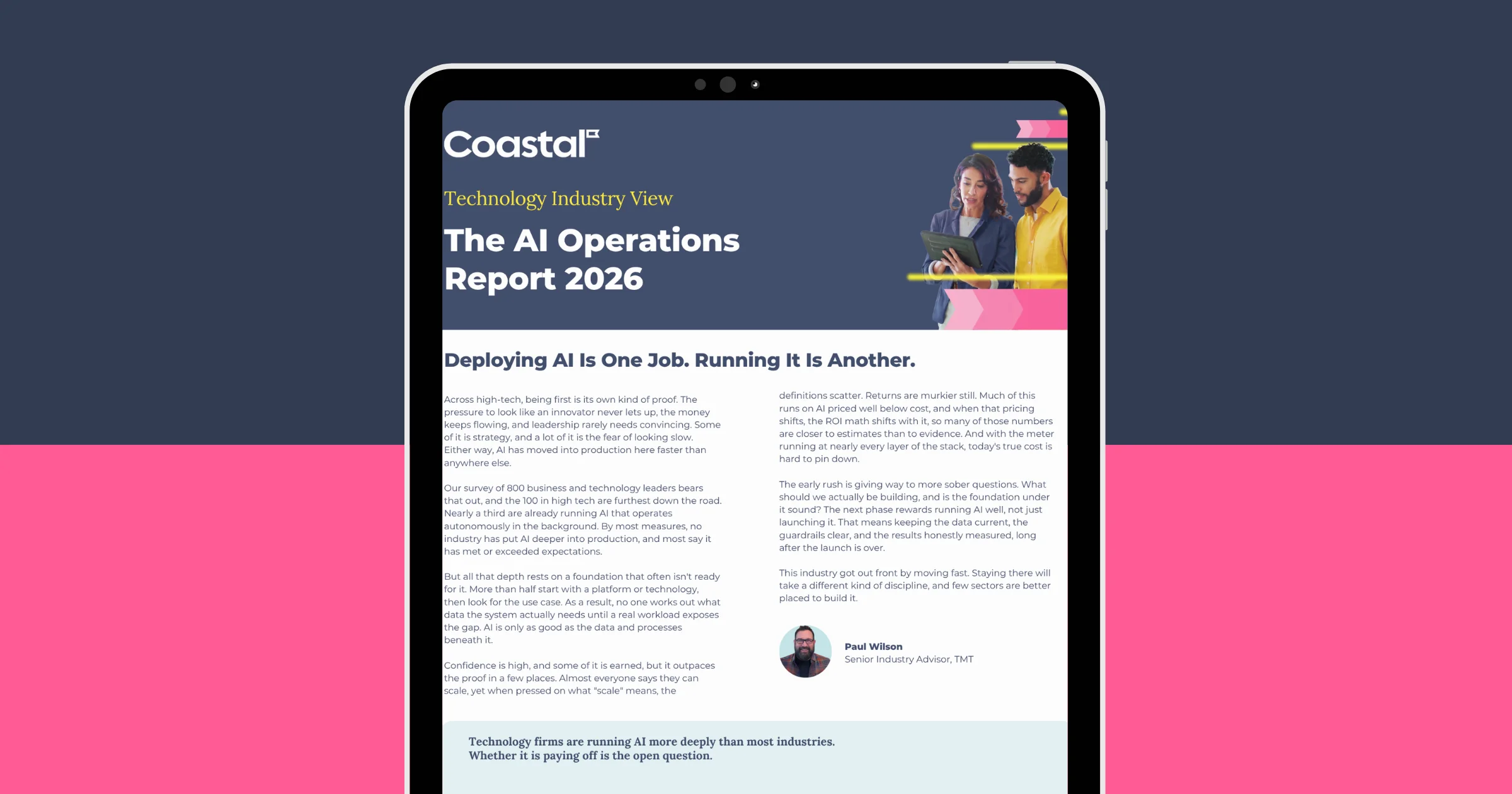

Technology organizations run more AI in production than most other industries. The stage where it breaks down is not the one you’d predict.
To better understand the core AI implementation challenges in high tech, Coastal’s 2026 AI Operations Report, conducted with Oxford Economics, surveyed 800 U.S. business and technology leaders with AI running in production today. Among the 100 in high tech, 61% are running four or more AI initiatives at once, compared to 40% across the broader market.
Yet 53% report that these initiatives stall or fail during build and configuration — compared to 40% market-wide.
Moving quickly to put multiple initiatives in production means high tech companies encounter build bottlenecks earlier and more frequently than standard market adopters. What stalls at the build stage almost always traces back to what happened before code was written.
Where AI Projects Stall in High Tech: Data Readiness First
Data is the first thing that reaches the build, making data readiness for AI the primary bottleneck where high tech stalls more often than anywhere else by a wide margin. 79% of these organizations name data access, quality, or preparation among the stages where AI initiatives most commonly stall or fail. Across the survey, 70% do. No other stage comes close in either group.
The pattern shows up in which use cases succeed early. Customer service tends to work because it runs on structured, historical records the AI can learn from: cases, resolutions, and escalation paths already captured in the CRM. Apply that same approach to prospecting or other front-office work — where underlying records are scattered across systems and inconsistently maintained — and the output reflects what it was given.
The difference between those two outcomes is rarely the model. It’s what the model had to work with.
“Spending more time preparing internal datasets prior to model development may have produced better outcomes.” – CTO, High Tech
Addressing AI Implementation Challenges in the Build Phase
Sequencing explains why AI projects stall in high tech far more often than tooling. 51% of high tech organizations say their most recent AI initiative began with a platform or technology, with use cases identified afterward (vs. 43% survey-wide). That sequence helps explain why 37% then cite a lack of clear use cases as a primary limit on running successful pilots, against 27% market-wide.
Our TMT advisors describe this as deciding what to cook before anyone has checked whether the kitchen is stocked. The equipment is all there. The ingredients — the required data, the operational workflow, and a clear definition of success — frequently aren’t. Nobody finds out until a real workload goes looking for them.
That’s what a build stall frequently comes down to: engineers running into parts of the problem that were never specified, and resolving them mid-build, where every fix costs far more than it would have at design time.
It also explains why the solution is rarely another platform. When the constraint sits upstream of the build, replacing the tool simply moves the same problem to a new vendor.
High Tech AI Operations: The Market Correction Already Under Way
That realization is starting to surface at the market level, not just inside individual programs. Our advisors describe a market that went from barely touching AI to running several initiatives at once without much of a middle phase. Competitive pressure rewarded speed, and the organizations that moved first had little reason to slow down and formalize process.
What follows a period like that is usually a correction. The changing tone of leadership conversations points that way: less focus on what AI could do, and more scrutiny on what current deployments are resting on (and whether that foundation holds as use cases multiply).
Nothing about that correction requires slowing down. It simply requires knowing which parts of the digital estate can carry weight and which can’t.
The AI Measurement Challenge Competing for Priority
Asked where they plan to focus next, only 17% of high tech organizations cite better measuring AI ROI on existing investments (vs. 26% survey-wide). Meanwhile, 43% say difficulty measuring pilot success is already limiting how many projects they can launch.
The measurement difficulty is widely recognized, but formal tracking often takes a back seat to launch speed.
Some of that is structural. A lot of what these deployments run on is priced well below what it costs to serve, and when that pricing moves, the ROI math moves with it. Calculating returns against subsidized pricing gives you an estimate rather than evidence.
While shifting economics make tracking trickier, capturing early baseline metrics is what ultimately protects project funding when the next budget review arrives. Efficiency gains are the leading indicator that something is working; business impact is what survives a budget review. That impact requires a baseline captured before launch and tracked after it. The next budget cycle will demand those numbers whether anyone has prepared them or not.
What the High Tech AI Report Covers
Data doesn’t stop being the constraint once something goes live. The full high tech industry report explores what happens to that 79% post-launch: how deep AI actually runs across these 100 organizations, whether leader confidence matches reality, and who ultimately owns performance once the solution goes live.
It closes with the five disciplines to put in place before the next pilot reaches production.
Findings reflect responses from 100 high tech organizations in Coastal’s 2026 AI Operations Report, a survey of 800 U.S. business and technology leaders conducted in partnership with Oxford Economics. All respondents have at least one AI initiative in production today. Some figures cited here come from underlying survey data and do not appear in the published industry report.